Abstract
Artificial intelligence is not new. However, the emergence and wide availability of large language models has meant that we are now in the midst of a technological paradigm shift – one where our technology is now able to communicate in human language. Alongside this, questions are arising about ethical use of technology more broadly, which is what I try to wrestle with in this presentation.
I look to some of the work on the Rome Call on AI Ethics as well as the publication of Magnifica Humanitas, the encyclical by Pope Leo XIV, as well as my own framework for taking action in this space.
Key takeaways
- We should not be afraid of new technology, but rather should be focused on harnessing it for good. As Pope St John Paul II put it in his apostolic letter "The Rapid Development" in 2005:
"Do not be afraid of new technologies! These rank “among the marvellous things” – inter mirifica – which God has placed at our disposal to discover, to use and to make known the truth, also the truth about our dignity and about our destiny as his children, heirs of his eternal Kingdom."
- While the default purpose of technology seems to be to "do more" of whatever we were doing before, I like to think about seeking a higher purpose to which we should orient our activities.
- When we look at the current state of AI – particularly generative AI – and compare just the amount of development from 2023 to 2026, we see an incredible amount of progress. At the same time, we see opportunities to improve our approach to 'algorethics' – a term coined by Rev. Paolo Benanti, the AI advisor to the pope. He was also a primary instigator of the 'Rome Call on AI Ethics' that summarised six principles that should be used to govern the development of AI and algorithims:
- Accountability: There must always be someone who takes responsibility for what a machine does
- Reliability: AI must be reliable
- Inclusion: Must not discriminate against anyone because every human being has equal dignity
- Impartiality: AI systems must not follow or create biases
- Transparency: AI systems must be understandable to all
- Security and Privacy: These systems must be secure and respect the privacy of users
- Some of the largest tech companies in the world have signed up to this call, which actually pre-dated the launch of large language models (LLMs), but hold as a good thing to use to assess current capabilities.
- When it comes to taking action, it is good to consider the call from Pope Leo XIV in his Address to the conference “Artificial intelligence and care of our common home”, December 2025:
"Human beings are called to be co-workers in the work of creation, not merely passive consumers of content generated by artificial technology."
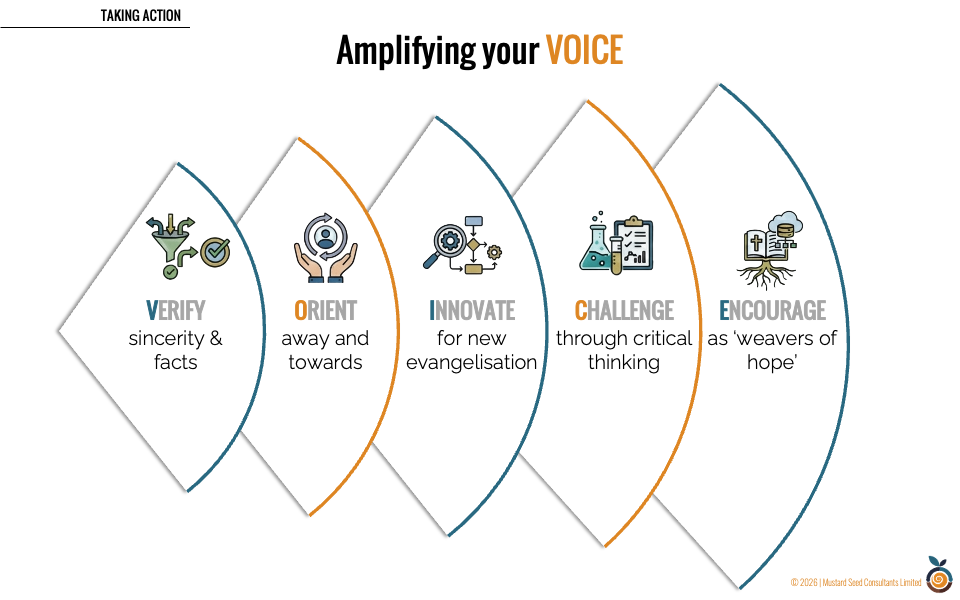
- So, I propose a framework to shape action – particularly for those involved in digital ministry and communications. The VOICE framework is inspired by Magnifica Humanitas, Pope Leo XIV's encyclical: